The relationship between sleep and health is a key scientific question. Sleep is essential to stabilize mood and maintain health. Sleep is closely related to mood, and sleep disorder can cause or aggravate negative mood. As one of the most prevalent daily factors, excessive stress undermines our health and leads to emotional illness. For example, stress correlates with an increased risk of clinical anxiety. Sleep has been suggested to be one of the mechanisms for alleviating the malign effects of stress. However, we still know little about its brain mechanism. Our laboratory deploys cutting-edge approaches to study how the brain connects stress, sleep and mood. Our goal is to explore neural circuits linking sleep and emotion and elucidate the neurobiological mechanism of how sleep mitigates stress-induced mood deficits; and ultimately, to unravel therapeutic targets or novel interventions for more efficacious treatments of mood disorders through the stress-sleep-emotion framework.
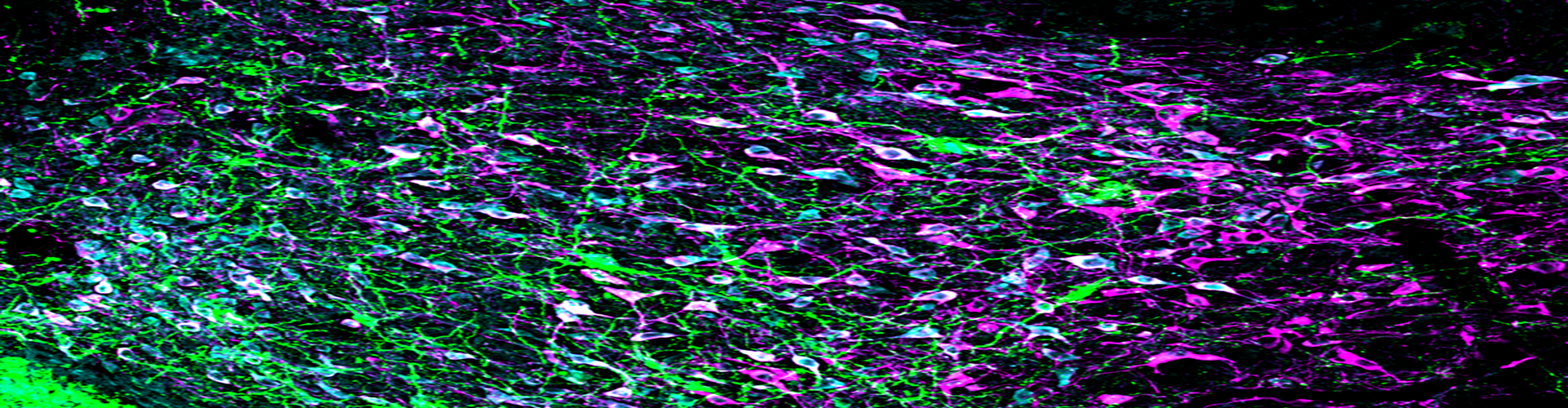
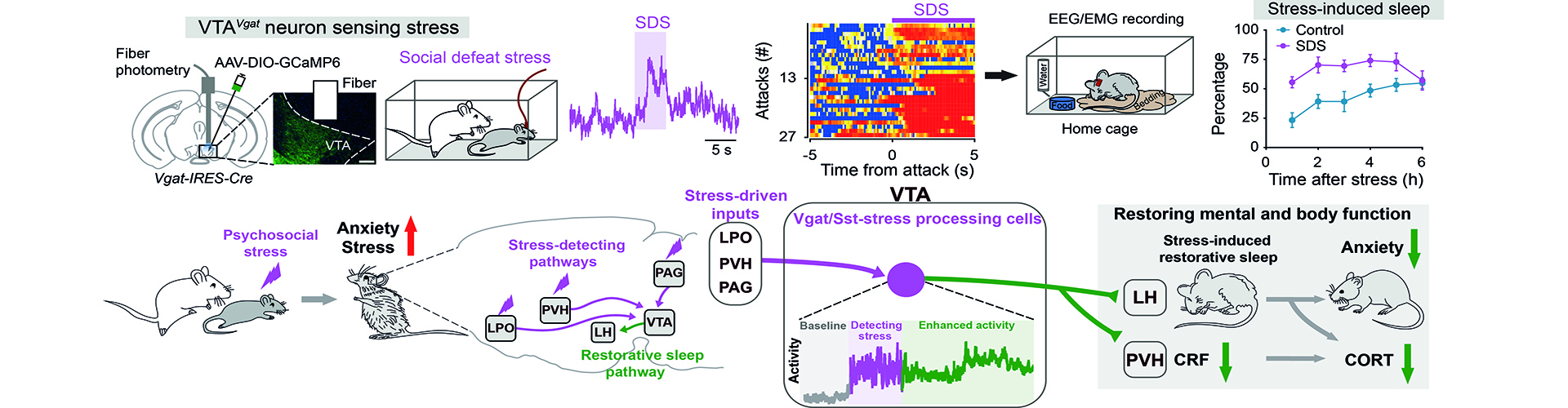
Our pioneer work investigated ventral tegmental area (VTA) GABAergic circuits controlling sleep-wake behavior and also how stress is engaged in the circuits. The activity of VTAGABA neurons correlates with brain states that powerfully regulate vigilance states (Nature Neuroscience, 2019). Dysfunction of these VTAGABA neurons elevates mood and produces main-like qualities, implicating the importance of these cells for mood control (Molecular Psychiatry, 2021). The VTA regulates sleep-wake behaviors. It also influences responses to stress and threats. We recently discovered a specific subset of VTAGABA neurons that sense social stress and induce restorative sleep through the lateral hypothalamus. Stress-induced sleep generated by this pathway alleviated stress levels and mitigated stress-induced anxiety, restoring mental and body functions (Science, 2022). The research interests of our laboratory include:
1) Neurocircuitry linking stress, sleep and mood
Our laboratory aims to reveal the key neurons and circuits linking stress, sleep and mood.
2) What are the restorative functions of sleep?
3) How does sleep mitigate stress-induced emotional distress?
We are investigating the restorative function of sleep by how it restores the features of brain networks that were dampened by stress and unravel the brain mechanism of how sleep contributes to alleviating stress-induced emotional distress.
4) Development of novel interventions for mood disorder
The brain targets and mechanisms of many drugs for the treatment of mood illness are not yet clear, and these drugs have certain side effects. The development of novel targeted small-molecule drugs can increase specificity and reduce side effects. We will use the stress-processing framework to develop novel interventions for mood illness.
5) How external inputs control behaviors?
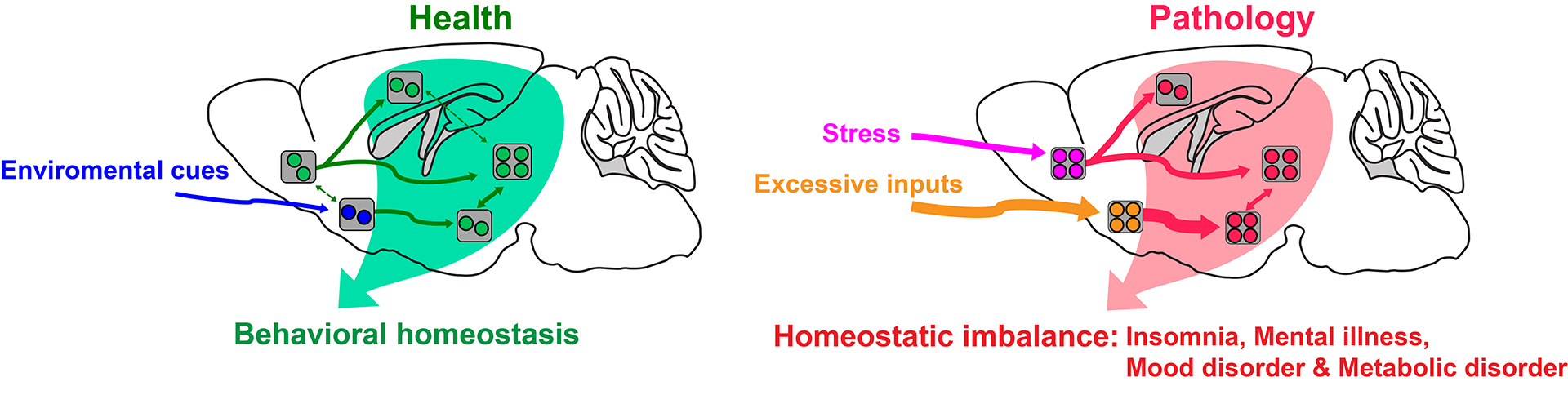
Behaviors are controlled by both external and internal factors. Our lab is also interested in understanding how the brain senses external signals, and integrates, processes and transforms these signals to maintain homeostasis; Especially how negative cues lead to pathological conditions, such as insomnia, mood disease and metabolic disease.

Investigator