Time:2025-11-20
On November 18, 2025, Neuroscience Bulletin published a research article titled "The Dorsal CA2 to Ventral CA1 Circuit Contributes to Spatial and Context-Dependent Memories." This insightful study, led by Dr. Chun Xu’s research group at the Institute of Neuroscience, Center for Excellence in Brain Science and Intelligence Technology, Chinese Academy of Sciences, sheds new light on the hippocampal role in memory processing. Using state-of-art techniques including single-neuron projectome analysis, circuit tracing, fiber photometry recording, and optogenetics manipulation, the team revealed the critical function of the dorsal CA2 (dCA2) axon projections to ventral CA1 dorsal part (vCA1d) in spatial and context-dependent memories, offering novel perspectives on the hippocampal CA2 neurons.
The hippocampus is a key brain region for memory and cognition, and consists of classic DG-CA3-CA1 tri-synaptic circuit. While prior studies have highlighted CA2’s role in social memory, how CA2 neurons contribute to spatial and context-dependent memories remains largely unclear.
Combining single-neuron projectome analysis of CA2 neurons and circuit tracing methods, the team discovered that CA2 neurons sent their strongest axon projections in the longitudinal direction, with the strongest axon projections targeting vCA1d. At the single-cell level, individual CA2 neurons exhibited preferential axon projections to dCA1 and vCA1d, respectively (Figure 1).
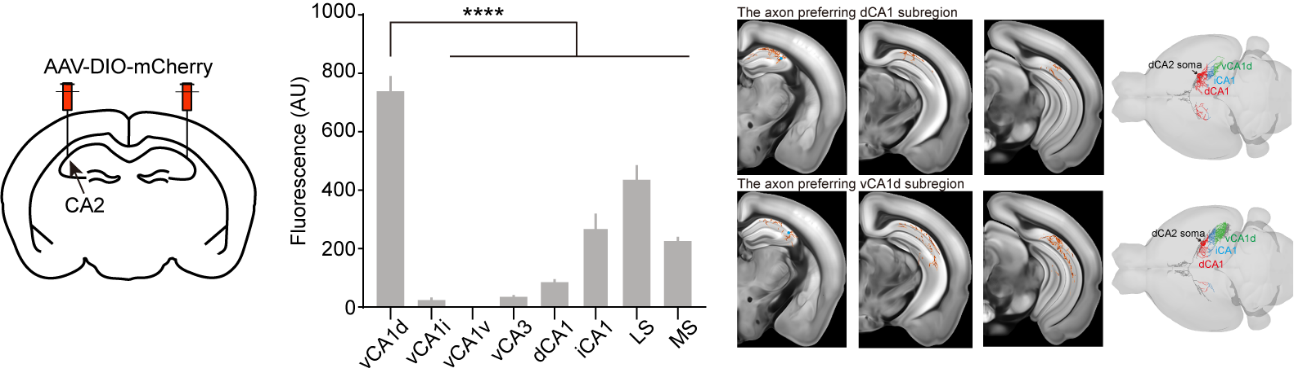
Figure 1: Preferential axon projections from dCA2 neurons to dCA1 and vCA1d.
In novel object and location recognition tasks, dCA2 neurons exhibited robust calcium responses to objects but gradually decreased with repetitive exposures. During memory tests, dCA2 neurons showed specific calcium responses to familiar locations, but smaller responses to old objects (Figure 2A). Optogenetic inhibition experiments revealed that the dCA2-vCA1d circuit is critical for encoding object location memory (but not object identity), as blocking this pathway significantly impaired the ability to recall object location (Figure 2B). Furthermore, the team recorded significant neuronal responses to aversive emotional stimuli such as aversive foot shocks (Figure 2A). Moreover, inhibiting the dCA2-vCA1d projection during learning impaired the formation of context-dependent fear memory (Figure 2B). These findings highlight a broad role of dCA2 neurons in spatial and context-dependent memories and underscore the pivotal function of the dCA2-vCA1d circuit.
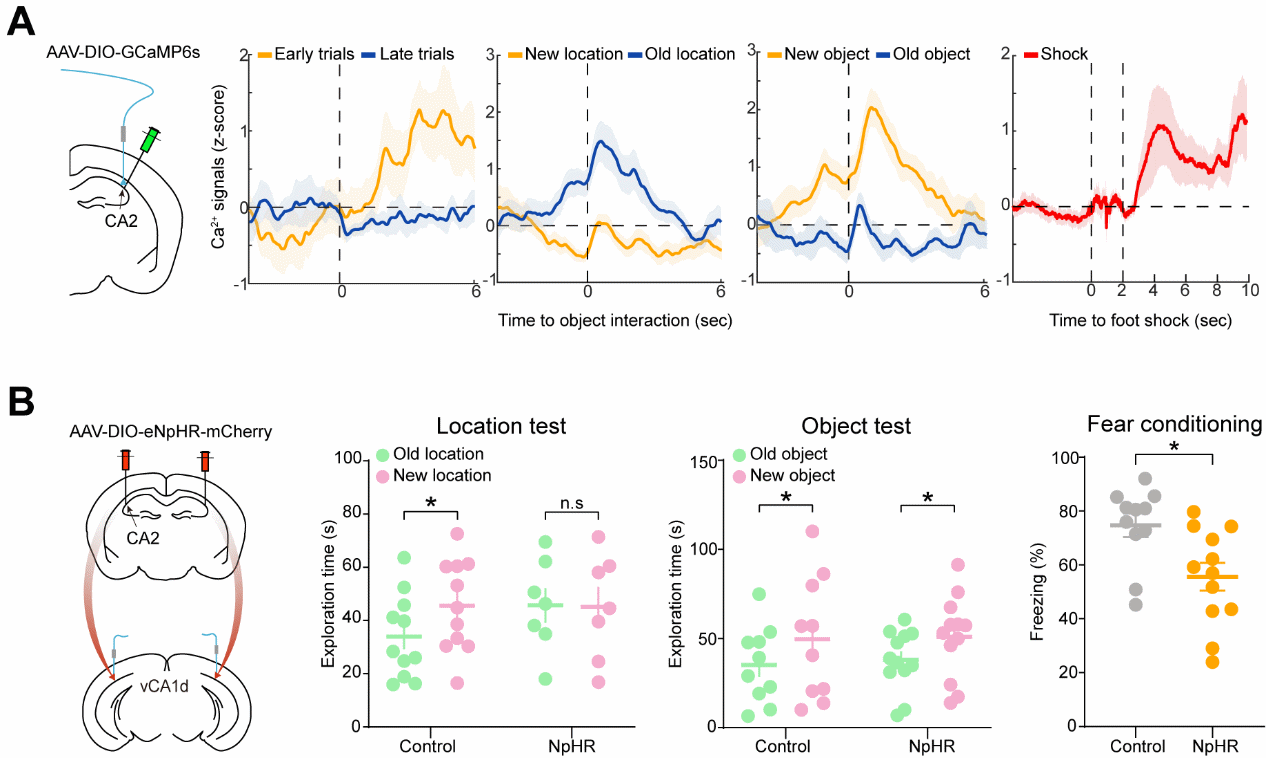
Figure 2: The role of dCA2 in spatial and context-dependent memories. A, dCA2 neurons showed specific calcium signal responses to object interaction and foot shock. B, inhibition of dCA2-vCA1d circuit impaired the location memory and fear memory of mice.
In summary, the research team leveraged the single-neuron projectome data of hippocampal neurons, combined with neural circuit methods including circuit tracing, calcium imaging, and optogenetics, to deeply elucidate the critical role of the longitudinal circuit of dCA2-vCA1d in spatial and context-dependent memories. This study provides novel insights for understanding the neural mechanisms underlying the memory functions of CA2 neurons. It highlights the pivotal role of the longitudinal circuit within the hippocampus in memory processing and memory-related disorders.
The study’s first author is Ning Li, a PhD candidate jointly trained by the Center for Excellence in Brain Science and Intelligence Technology and Fujian Medical University. Principal investigator Chun Xu, Professors Xiaochun Chen and Jing Zhang from Fujian Medical University, and Principal investigator Lin Xu from the Kunming Institute of Zoology serve as co-corresponding authors. Bingqing Zhao, Xiaowen Shen, and others from Dr. Chun Xu’s team also made significant contributions to this study. This study was supported by the National Science and Technology Innovation 2030 Major Project, the Chinese Academy of Sciences, and the National Natural Science Foundation of China.
Keywords: Spatial memory; Contextual memory; Hippocampus; CA2; Longitudinal circuit; Single-neuron projectome; Fiber photometry; Optogenetics
AUTHOR CONTACT:
XU Chun
Institute of Neuroscience, Chinese Academy of Sciences, Shanghai, China.
E-mail: chun.xu@ion.ac.cn
Lab webpage: http://english.cebsit.cas.cn/lab/xuchun/research/
 附件下载:
附件下载: 
